



.webp)












.webp)






Help our experts understand you better by filling our 2-Minute Form, to find the right education loan
Get instant loan offer suitable to your profile !

On this Page:
A clear, current guide to the PTE exam in India for 2026 — fees, format, score requirements, and what Pearson's August 2025 scoring update actually means for memorised-template prep.

Quick Summary:
| Question | Short Answer |
|---|---|
|
What is PTE? |
A fully computer-based English test for study, work, and migration, scored 10–90 |
|
What changed in 2026? |
Two new speaking tasks (from 7 Aug 2025) + a human-review layer added on top of AI scoring |
|
Does the old template strategy still work? |
Riskier than before — the new tasks and review layer favour spontaneous, original responses |
|
Fee in India |
INR 18,900 for PTE Academic, UKVI, and Core; INR 15,300 for PTE Home (official Pearson pricing) |
|
Results |
Typically 2 days, max 5 |
|
Score validity |
2 years |
|
Who accepts it |
3,500+ institutions; governments of UK, Australia, Canada, New Zealand |
|
Biggest student mistake |
Treating PTE as a memorisation game instead of a fluency test |
Most guides will tell you the PTE exam is a fast, AI-scored English test that gets you results in two days. True. They will list the fee, the four skills, the score comparison with IELTS, and call it a complete overview. Here is what almost none of them will tell you clearly: in August 2025, Pearson changed how the test is scored and what it tests. And those changes quietly undercut the single most popular way Indian students are coached to clear it: memorising templates.
If you are still preparing the way students did in 2023, you are preparing for a test that no longer exists in quite the same form. This guide covers the boring-but-essential parts (PTE exam details, fees, format, scores) and then the part that actually decides whether you score 79+ or stall at 65.


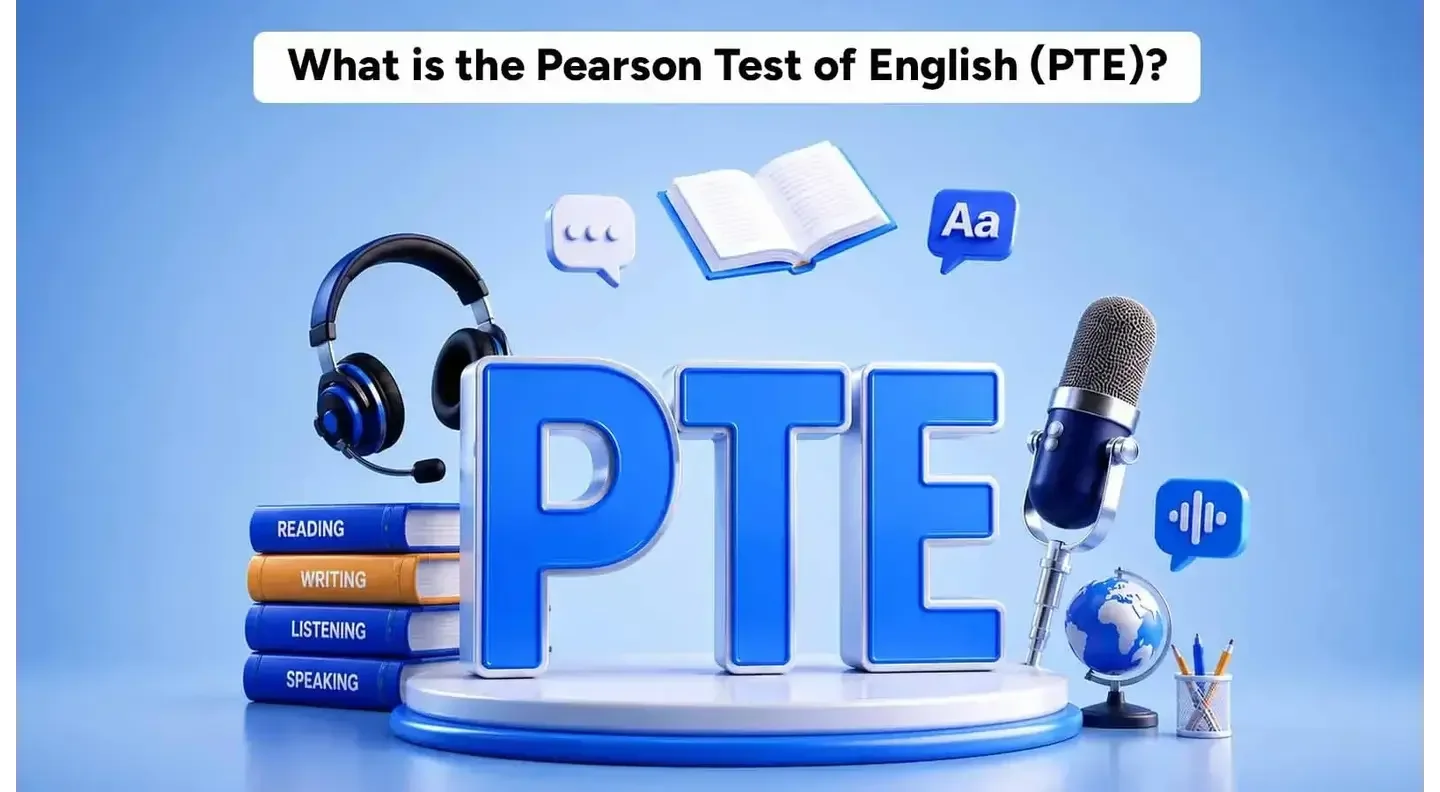
The full form of PTE is the Pearson Test of English. It is a fully computer-based PTE English exam that measures Reading, Writing, Listening, and Speaking, and it sits alongside IELTS and TOEFL as a globally accepted proficiency test. The headline appeal for Indian students is simple: results in about 48 hours, near-daily test slots, and scoring by machine rather than a human examiner sitting across from you.
That last point matters more than students realise, and we will come back to it.
There are four variants of the test, and picking the wrong one is a surprisingly common and expensive mistake:

A practical note that trips people up: the August 2025 changes apply to PTE Academic and PTE Academic UKVI only. PTE Core and PTE Home tests remain unchanged. So if you are testing for Canada via PTE Core, the new tasks below do not apply to you.
According to Pearson's own updates page, the changes apply to any test taken after 7 August 2025, and they keep the same sections and original 20 question types while adding two new ones.
The two new question types, both in the Speaking & Writing section:
One detail most overviews skip: while the question types rose from 20 to 22, the total number of questions actually dropped from the earlier 70-82 to roughly 52-64. The test is shorter on volume but heavier on the kind of tasks you cannot rehearse, which is the whole direction of the change.
The scoring change is where guides either overclaim or undersell. Here is the honest version. Pearson states that responses to some questions are now part-scored by humans as well as AI, though humans never check pronunciation or fluency, and the test has enhanced scoring criteria for some tasks. News coverage of the official announcement went further, reporting that Pearson enhanced its AI scoring system to detect copied or unoriginal responses, to ensure fair and more accurate assessments
Put those two facts together and the implication is hard to miss, even though Pearson has not published a "we penalise templates" rule in plain words. A new human-review layer plus two unscriptable tasks plus an enhanced focus on original responses all point in the same direction: the test is being engineered to reward genuine communication over rehearsed patterns. We are reading the signal here, not quoting a rulebook but the signal is consistent across the official page and the official statement.
Here is the part that comes from watching how Indian students actually prepare, not from a brochure.
Two things now work against that.
To be precise about what we know versus infer: Pearson confirms the human layer and the new tasks. The "templates now hurt you" conclusion is our analysis of where that leads. But if your prep budget is going entirely into memorising frames, you are betting against the clear direction the test is moving. That is the blind spot.
The structure stayed the same; two tasks were added. The test runs roughly two hours in one sitting, and the total duration remains approximately 2 hours, with the per-question time limits unchanged so you face no extra time pressure.
| Section | Skills Assessed | Notable Task Types |
|---|---|---|
|
Speaking & Writing |
Speaking, Writing |
Read Aloud, Repeat Sentence, Describe Image, Re-tell Lecture, Summarize Written Text, Essay, plus the two new tasks: Summarize Group Discussion and Respond to a Situation |
|
Reading |
Reading |
Fill in the Blanks, Multiple Choice, Re-order Paragraphs |
|
Listening |
Listening |
Summarize Spoken Text, Multiple Choice, Fill in the Blanks, Highlight Correct Summary, Write from Dictation |
A detail worth internalising for the PTE academic exam pattern: tasks are integrated, meaning one task can feed multiple skill scores. Summarize Written Text affects both Reading and Writing. This is why scattershot prep underperforms while improving one targeted skill can lift several scores at once.
Now the part everyone searches for, and here the official Pearson pricing is unambiguous. According to Pearson's official test centres and fees page, the fee in India is INR 18,900 for PTE Academic, PTE Academic UKVI, and PTE Core, and INR 15,300 for the PTE Home tests (A1, A2, B1). Pearson also lists 57 test centres across India, in cities including Ahmedabad, Bangalore, Chandigarh, Mumbai, and New Delhi.
A point worth flagging because students get this wrong constantly: there is no separate "PTE Academic Online" price tier to hunt for, and the cheaper INR 15,300 figure floating around online is the PTE Home fee, not a discount on the Academic test. If you are studying abroad, your fee is INR 18,900. Treat anything materially lower as a different test type or a third-party voucher offer, not the base Pearson price.
Rescheduling and cancellation, as commonly applied: rescheduling is free if done more than 14 days before the test and unavailable within 14 days; cancellation gives a full refund if done at least 14 calendar days before the test date.
One small operational trap that genuinely costs students their slot: the Pearson payment portal is an international gateway, and many Indian debit cards have international e-commerce transactions disabled by default. Enable that in your banking app before booking. Students assume their card was declined for lack of funds, panic, and lose the slot they wanted.
The Pearson PTE academic test is accepted by over 3,500 institutions worldwide and by the governments of the UK, Australia, Canada, and New Zealand for visa purposes. Rough score bands by study level: foundation programmes around 36–50, undergraduate around 51–60, postgraduate around 57–67. These are indicative, not absolute, always check your specific programme's page.
A 2026-specific point students miss: Pearson notes that for Australian DHA visa applications, some score requirements changed from 7 August 2025. If you are on an Australia track, do not rely on a 2024 cutoff you saw on a forum.
If you took PTE before August 2025 and are worried your score is now stale, you are fine: score reports from before August 2025 remain valid for the full 2 years, and the score report format has not changed.
Eligibility is genuinely simple, so we will not pad it: minimum age 16, parental consent if under 18, no specific educational qualification, open to all nationalities. Registration is online via the official PTE site, choose your test type and destination, pick a centre and slot, create your myPTE account, and pay by Visa, MasterCard, or American Express.
The one mistake that derails this stage: your name on the booking must match your passport exactly, including middle names. A mismatch can mean denied entry on test day with no refund. This is not a paperwork formality; centres enforce it strictly.
If templates are a fading strategy, what replaces them? Practical, current advice grounded in how the test now behaves:
The clearest signal about the 2025 update is not in Pearson's marketing, it is in how PTE coaching platforms have rewritten their own advice. Sites that built their reputation on template banks now tell students the same thing: rote answers are a risk. One platform states the goal is to reduce overdependence on templates and reward natural, context-appropriate speech, with candidates now tested on their ability to think on their feet. Another frames the system as now rewarding genuine engagement with the task rather than memorised speech, which matters most in the new speaking tasks where originality and relevance carry the most weight. When the businesses that sell templates start warning against templates, that tells you where the test is heading. Student communities on Reddit's r/PTE have echoed the same uncertainty since August 2025, with the recurring question being whether old template strategies still work. The documented answer, from both Pearson and the coaching ecosystem, is that originality now carries more weight than it did before.
The PTE exam in India in 2026 is still fast, still computer-based, still accepted nearly everywhere that matters. What changed is subtle but real: the test now actively rewards real communication and quietly disadvantages the rehearsed-pattern approach that an entire coaching ecosystem was built on. The students who adjust their prep to this shift will clear it comfortably. The ones who do not will keep blaming the AI.
Clearing the English test is only the first checkpoint. The far bigger one is paying for the degree behind it and that is where most students start too late. GyanDhan has facilitated over ₹11,000 crore in education loans for 35,000+ students, and the single clearest pattern in that data is that early financial planning removes the panic that derails applications. Before your PTE date is even booked, it is worth knowing what you can actually borrow. You can check your education loan eligibility for free in 2 minutes and see your collateral-free options without any commitment.

The full form of PTE is the Pearson Test of English.
PTE Academic scores are valid for 2 years from the test date, though some institutions set their own expiry, so confirm with your target institution.
Pearson says no. The updates let test-takers showcase a broader range of English skills and keep the same CEFR alignment, but do not make the test more difficult. In practice, it is harder for students relying on memorised templates and arguably easier for those with genuine spoken fluency.
No. The changes apply to PTE Academic and PTE Academic UKVI only.
INR 18,900 for PTE Academic, PTE Academic UKVI, and PTE Core. The PTE Home tests cost INR 15,300.
Mostly. AI still does the bulk of scoring, with a human-review layer now added for some responses but humans never assess your pronunciation or fluency.
Check Your Education Loan Eligibility

Ask from a community of 10K+ peers, alumni and experts
Be the first to discuss this article
Ask a question or share your experience with students on GD Connect.
Add Your ResponseTrending Blogs
Similar Blogs

Network with a community of curious students, just like you
Join our community to make connections, find answers and future roommates..Country-Wise Loans
Best Lenders for Education Loan

ICICI Bank

Axis Bank

Union Bank

Prodigy

Auxilo

Credila

IDFC

InCred

MPower

Avanse

SBI

BOB

Poonawalla

Saraswat